
Custom fabrication projects depend on material consistency before machining, routing, welding, or forming begins. For procurement teams sourcing HDPE sheets in Winnipeg, technical specifications help confirm whether the material can meet dimensional, mechanical, and environmental performance requirements.
High-density polyethylene is widely selected because it combines impact resistance, low moisture absorption, chemical resistance, and good machinability. However, not every sheet grade performs the same. Verifying the following specifications helps engineers, designers, and fabricators select HDPE material that aligns with the application, processing method, and operating environment.
1. Specific Gravity and Density Ratings for HDPE Sheets
Specific gravity helps confirm the density classification of HDPE compared with lower-density polyethylene alternatives. HDPE has a more linear molecular structure, which supports higher crystallinity and improved stiffness compared with low-density grades.
This structure contributes to stronger load-bearing behaviour, better wear resistance, and more stable fabrication performance. For custom components, density ratings help determine whether the sheet can support the required balance of strength, weight, and machinability.
Compared with low-density alternatives, HDPE generally provides a higher specific gravity range and a more rigid material profile. Procurement teams should verify density values on the material data sheet before approving a sheet for machined or fabricated parts.
2. Thermal Expansion Coefficients in Polyethylene Sheet Applications
Thermal expansion is an important specification when a polyethylene sheet will be exposed to temperature changes during operation. HDPE expands and contracts more than many metals, so clearance, fastener placement, and joint design must be evaluated during fabrication planning.
Linear thermal expansion data helps engineers estimate dimensional movement across sheet length, width, and thickness. This is especially important for panels, liners, guides, guards, and fabricated assemblies installed in changing temperature conditions.
Continuous service temperature limits should also be reviewed before material approval. HDPE offers reliable performance across many industrial environments, but thermal contraction and expansion can be more noticeable than in rigid engineering plastics with lower movement profiles.
3. Flexural Modulus and Tensile Strength for HDPE Plastic Sheets
Flexural modulus indicates how stiff the material is under bending loads. Tensile strength helps determine how well HDPE can resist pulling forces before deformation or failure.
For HDPE plastic sheets, both values are important when designing fabricated parts that must handle impact, movement, sliding contact, or distributed loading. A sheet with suitable tensile and flexural properties can support better part stability during routing, drilling, fastening, and assembly.
Impact strength is one of HDPE’s key advantages in custom fabrication. Its stiffness profile supports reliable machining while maintaining enough toughness for demanding industrial applications.
For proper machining, fabricators should use sharp tooling, controlled feed rates, and effective chip removal. Consistent chip evacuation helps reduce heat build-up, improves routing precision, and supports cleaner edge quality during fabrication.
4. Moisture Absorption Rates for HDPE Sheets Winnipeg
Moisture absorption should be verified when sourcing HDPE sheets Winnipeg for wet, humid, or washdown environments. HDPE absorbs very little moisture compared with many alternative industrial plastics, which supports dimensional stability in applications exposed to water or repeated cleaning.
This property makes HDPE suitable for liners, cutting surfaces, guides, wear strips, and components used in damp mechanical settings. Low moisture absorption helps reduce swelling, distortion, and performance changes over time.
HDPE also provides useful dielectric properties, making it suitable for selected applications where electrical insulation is required in wet or exposed environments. Procurement teams should request data sheets from Johnston Industrial Plastics Limited to confirm moisture absorption values, dielectric performance, and grade suitability before fabrication begins.
5. UV Stabilization and Environmental Resistance Grades
Outdoor applications require HDPE grades that can withstand sunlight, weather exposure, and temperature variation. UV-stabilized HDPE contains protective additives designed to slow degradation caused by prolonged ultraviolet exposure.
This is important for outdoor panels, marine components, agricultural parts, construction barriers, and exposed fabrication projects. Without proper UV stabilization, colour retention, surface condition, and mechanical properties may decline faster in exterior environments.
Environmental resistance should also include chemical exposure, abrasion, and impact conditions. Industry usage trends continue to favour UV-stabilized HDPE for outdoor parts because it supports longer service life compared with non-stabilized grades in exposed settings.
6. Food-Grade Compliance and Surface Finish Options
Food-grade HDPE must meet the appropriate regulatory and application requirements for direct or indirect contact. Procurement teams should confirm whether the grade aligns with relevant standards, certifications, and documentation required for the intended use.
Surface finish also matters in food processing, packaging, and sanitary fabrication environments. A consistent finish supports easier cleaning, reduced material build-up, and improved fabrication quality.
Engineered resin properties help support a uniform sheet structure, which can improve machining consistency and surface performance. For compliance-driven applications, documented grade selection supports smoother audits and helps reduce approval delays during procurement and fabrication review.
7. How to Source HDPE Sheets and Finalize Your Procurement Strategy
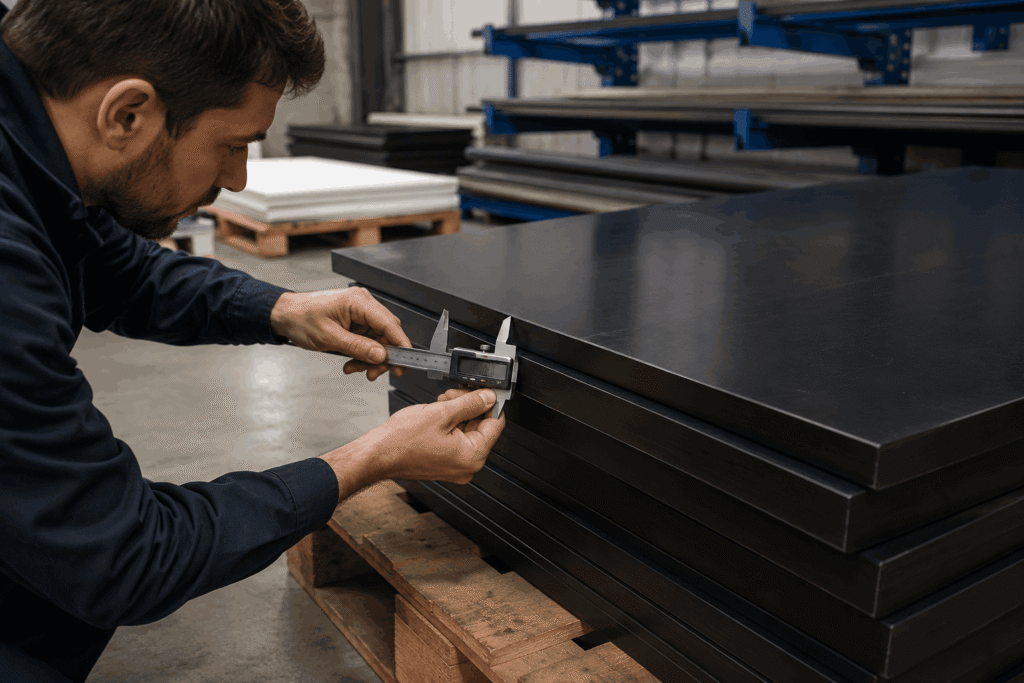
A strong procurement strategy should verify density, thermal movement, tensile strength, flexural modulus, moisture absorption, UV resistance, compliance requirements, and surface finish. These specifications help confirm whether HDPE is suitable for the fabrication method and operating environment.
Regional buyers should also consider local inventory, custom gauge availability, cutting capabilities, and technical support. Reliable access to material can reduce lead time pressure and improve scheduling for fabrication shops managing multiple active projects.
Supply chain resilience remains a key factor for industrial buyers. Working with a knowledgeable supplier helps procurement teams reduce material uncertainty, confirm specification fit, and support repeatable fabrication outcomes.
Final Thoughts
Buying HDPE for custom fabrication requires more than checking sheet size and price. The correct grade must match the required strength, thermal behaviour, moisture resistance, environmental exposure, compliance needs, and machining process.
For engineers, designers, fabricators, and procurement teams sourcing HDPE sheets in Winnipeg, proper specification review helps reduce rework, improve part performance, and support long-term reliability. Contact Johnston Industrial Plastics Limited to request technical data sheets, confirm custom gauge availability, and receive a quote for HDPE sheet materials suited to industrial fabrication requirements.