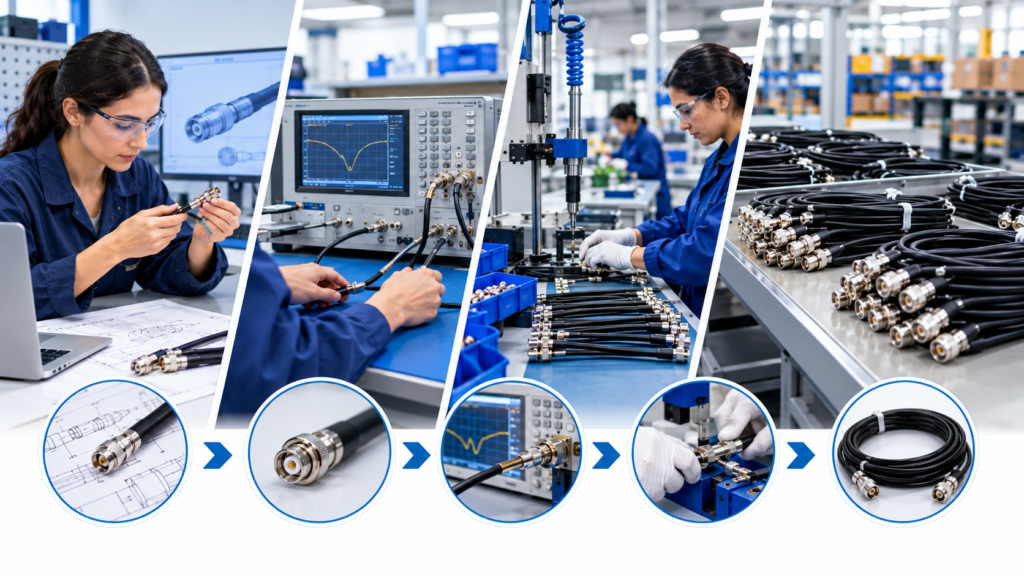

A radio frequency (RF) cable prototype can pass every bench test and still struggle in production. One technician builds it by hand, tunes each termination, and tests it once. The first volume order tells a different story, with readings that drift from unit to unit.
People Also Ask
What are custom coaxial cable assemblies?
They are coaxial cables cut to a defined length and terminated with connectors chosen for a specific application, impedance, and routing need.
What does a first article inspection confirm?
It confirms that parts built with production materials, tooling, and methods match the drawing and specification before the full run begins.
This gap is common. Prototype builds may use different tooling, preliminary materials, or work instructions that are still being refined. Small variations in strip length, crimp quality, or contact position stay hidden until volume exposes them.
The impact reaches well beyond the cable. Inconsistent assemblies lead to failed system tests, rework, delayed shipments, and field returns. In RF systems, one weak interconnect can degrade an entire product’s performance.
A structured transition plan closes that gap. This guide shows how engineering and procurement teams can move custom coaxial cable assemblies from prototype to volume production with fewer surprises.
Why Prototype Builds Do Not Predict Volume Results
A working prototype proves the design can work.It does not prove that the process can consistently reproduce the assembly in volume production.
Several conditions change between the two stages:
- Tooling: Prototypes often use hand tools, while production relies on calibrated crimp tools, dies, and fixtures.
- Materials: Early builds may use sample connectors or short cable lengths from distributor stock. Production draws from full reels and new material lots.
- People: One experienced builder becomes several operators across shifts, each with slightly different technique.
- Testing: A single prototype gets full attention. Volume builds need a defined test plan that fits production flow.
RF performance is sensitive to small dimensional changes. A center contact seated slightly out of position can disturb impedance at the connector interface. So can a dielectric trimmed a little short. On one prototype, that variation may never appear. Across a production lot, it shows up as scattered return loss results and unexpected failures.
Design Review for Custom Coaxial Cable Assemblies
A cable assembly design review catches manufacturability issues while changes are still inexpensive. The goal is to confirm that the design can be built the same way every time, not just once.
A useful review covers five areas:
- Cable and connector compatibility: Each connector must suit the exact cable construction, including dielectric and jacket dimensions. A near match may assemble but perform poorly.
- Cable type: Flexible, low-loss, semirigid, and conformable cables each handle bending, forming, and termination differently.
- Bend radius and routing: Tight bends near the connector stress the termination. Right-angle connectors or suitable strain relief can help, as long as the design meets bend radius and clearance requirements.
- Electrical requirements: Impedance, frequency range, insertion loss, and return loss or VSWR (voltage standing wave ratio) limits should appear as measurable values.
- Operating environment: Temperature, vibration, moisture, and flex cycles all influence material choices. Aerospace assemblies may face sustained vibration, while marine equipment sees moisture and salt exposure.
Tolerances deserve a close look too. A length tolerance tighter than the application needs adds cost without adding value. Phase-matched sets require controlled electrical length. Other applications may need tight physical tolerances for fit and routing.
What the Drawing Package Should Include
A complete drawing package, built on how OEMs specify custom coaxial cable assemblies, turns a successful prototype into a repeatable build. Documentation gaps force the assembler to guess, and guesses create variation.
| Element | What it should define |
|---|---|
| Assembly drawing | Overall length, length tolerance, and the reference points used to measure length |
| Bill of materials | Cable and connector part numbers, plus any approved alternates |
| Termination details | Strip dimensions, crimp requirements, and contact position per the connector maker’s instructions |
| Electrical test requirements | Required tests, frequency range, and pass or fail limits |
| Workmanship standard | The workmanship requirements and acceptance criteria specified for the assembly |
| Marking and labeling | Part number, revision, and serial or lot code for traceability |
| Packaging | Coil size, connector caps, and protection during shipping |
Revision control matters as much as content. Each change should carry a new revision letter and a short note describing it. Procurement and production teams then work from the same version.
First Article Builds and Approval Steps
A first article build checks whether production methods produce assemblies that meet the released drawing and specifications. It uses production materials, production tooling, and the released drawing revision.
A practical approval sequence looks like this:
- Build a small first article lot under normal production conditions.
- Inspect dimensions and workmanship against the drawing and workmanship standard.
- Run the full electrical test set and record results by serial number.
- Perform destructive checks where specified, such as pull tests on sample crimp terminations.
- Submit the inspection and test report to the OEM for review.
- Obtain written approval before releasing volume orders.
Approval establishes the tooling, materials, and methods as the production baseline. Later changes follow documented change control.
Some aerospace and defense programs require a specific first article report format. Procurement teams should state that requirement in the purchase order. Any later change to materials, tooling, or process should trigger a new review, which may mean a partial or full first article.
Material Sourcing and Availability Planning
Prototype connectors often come from distributor shelves in small quantities. Volume production reveals whether those parts are truly available at the needed scale.
Specialty RF connectors and certain cable types can carry long lead times and minimum order quantities. Cable usually ships on reels, so plan cut lengths to limit scrap.
Practical steps reduce sourcing risk:
- Qualify alternates early: A substitute connector can change electrical performance. Test and approve alternates before a shortage forces a rushed decision.
- Check lifecycle status: Confirm that no connector or cable is approaching end of life before production release.
- Share forecasts: Rolling forecasts help the assembler order long lead materials ahead of demand.
- Use buffer programs where needed: Safety stock or Kanban arrangements can protect schedules for steady demand items.
- Record material lots: Lot traceability supports failure investigations, which matters most for aerospace, defense, and medical programs.
Inspection and Testing at Higher Volumes
Testing every parameter on every unit does not always scale. A volume test plan balances coverage, cycle time, and risk. The OEM and assembler should agree on which tests run on every unit and which run on samples.
Typical tests for coaxial cable assembly production include:
- Continuity and shorts: Confirms the center conductor and shield connect correctly and stay isolated from each other.
- Dielectric withstand voltage: Verifies insulation integrity between conductor and shield.
- Return loss or VSWR: Measures impedance matching across the specified frequency range.
- Insertion loss: Confirms signal loss stays within the specified limit.
- Visual and dimensional inspection: Checks length, connector alignment, and workmanship.
- Phase measurement: Applies to matched sets that require consistent electrical length.
Dedicated test fixtures reduce variation between operators and shorten each test cycle. Recording results by serial or lot number supports traceability. Trend data adds another layer of control. A shift in return loss can prompt checks of tooling, materials, terminations, and the measurement setup.
Moving custom coaxial cable assemblies into volume production succeeds when it follows a planned sequence. Design review, complete documentation, and first article approval help reduce problems discovered during production. Sourcing plans and a scalable test strategy then keep each lot consistent.
Star Engineering Inc. supports OEMs with custom RF coaxial cable assemblies from prototype through production. Support includes design review, design-for-manufacturability input, supply chain management, inspection, and functional testing. Contact Star Engineering Inc. to discuss coaxial cable assembly production requirements.
Frequently Asked Questions
How long does the move from prototype to volume production take?
Timing depends on design maturity, material lead times, and the first article approval cycle. Specialty connectors often set the pace.
What tests do RF coaxial cable assemblies need in production?
Production tests follow the approved specification and may include continuity, insulation tests, return loss or VSWR, and insertion loss. Matched sets also need phase measurement.
How do semirigid and flexible coaxial cables differ?
Semirigid cable holds a formed shape and suits fixed routing. Flexible cable supports easier routing and installation. Moving connections require cable specified for the expected flex cycles and bend radius.
Can a connector be substituted after first article approval?
Only after evaluation and testing. A different connector can change RF performance, so the OEM should approve the alternate first.
What Should a Request for Quotation Include for Custom Coaxial Cable Assemblies?
Include the drawing, bill of materials, quantities, forecast, test requirements, workmanship class, and packaging needs.
