
Manufacturing decisions often stall when selecting the right process for a component. Cost, precision, and scalability all influence outcomes. Choosing incorrectly can lead to delays, excess material waste, or inconsistent quality.
Understanding how custom sheet metal fabrication compares with CNC machining helps industrial teams make informed decisions early. This clarity becomes essential when evaluating manufacturing approaches for production efficiency and long-term performance.
What Is Custom Sheet Metal Fabrication?
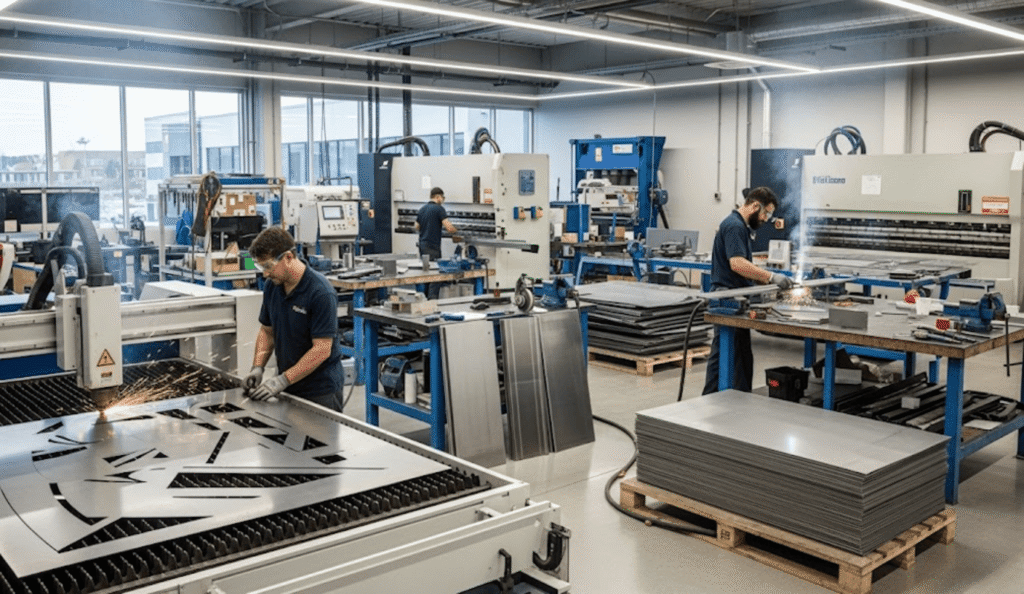
Custom sheet metal fabrication involves shaping flat metal sheets into functional components. The process typically includes cutting, bending, and forming.
Key characteristics include:
- Ideal for thin to medium-gauge materials
- Supports repeatable production runs
- Efficient for brackets, enclosures, and panels
- Works well with materials like steel and aluminum (excluding Aluminum 2024)
This process is widely used where consistency and scalability matter.
What Is CNC Machining?
CNC machining removes material from a solid block to create a final part. Many operations rely on 3-axis CNC machining to enable precise, repeatable manufacturing.
Core capabilities include:
- Tight tolerances and dimensional accuracy
- Suitable for complex geometries within 3-axis limits
- Effective for low to medium production volumes
- Strong performance with solid metal components
CNC machining is often selected when precision outweighs material efficiency.
Core Differences Between the Two Processes
While both processes support metal component production, their approaches differ significantly.
Sheet Metal Fabrication
- Forms parts from flat sheets
- Faster for high-volume production
- Lower material waste
CNC Machining
- Removes material from solid stock
- Higher precision for intricate features
- Slower for large production runs
Each method serves a distinct purpose based on design and volume requirements.
Cost Comparison: What Drives the Difference?
Cost depends on several production variables.
Custom sheet metal fabrication costs are influenced by:
- Material thickness
- Tooling setup
- Production volume
CNC machining costs are influenced by:
- Machining time
- Tool wear
- Complexity of geometry
In general, sheet metal fabrication becomes more cost-efficient at scale. CNC machining may carry higher costs due to longer cycle times.
When Custom Sheet Metal Fabrication Makes More Sense
Sheet metal fabrication is often preferred in scenarios such as:
- High-volume production requirements
- Parts with uniform thickness
- Components like enclosures or mounting structures
- Projects requiring consistent repeatability
This process supports streamlined manufacturing when designs align with forming techniques.
When CNC Machining Is the Better Choice
CNC machining becomes more suitable when:
- Tight tolerances are critical
- Parts require detailed features or pockets
- Production volumes are lower
- Solid block components are needed
3-axis CNC machining remains effective for many industrial applications without requiring advanced multi-axis systems.
Combining Both Processes in Real-World Manufacturing
Many industrial projects in sheet metal fabrication companies benefit from combining both methods.
For example:
- Sheet metal fabrication produces structural components
- CNC machining creates precision features or inserts
- Simple electromechanical assemblies integrate these parts efficiently
This hybrid approach improves flexibility and production efficiency without adding unnecessary complexity.
Design Considerations That Influence the Decision
Design plays a central role in process selection.
Important considerations include:
- Material thickness and formability
- Tolerance requirements
- Production volume
- Part geometry
Designs optimized for fabrication often reduce costs. In contrast, designs requiring precise features may favour machining.
Choosing the Right Process for Your Application
Selecting between custom sheet metal fabrication and CNC machining depends on balancing precision, cost, and scalability. Each method offers clear advantages when aligned with the right application.
Promark Tool and Manufacturing supports industrial manufacturing needs with practical, production-ready solutions. For projects requiring reliable custom sheet metal fabrication in Toronto, connect with the team to evaluate the most efficient approach.