
Industrial lifting environments that involve moisture, chemicals, or washdown conditions require materials that resist corrosion without compromising strength. Stainless steel lifting systems are commonly used in marine, food processing, and chemical facilities where standard alloy components may degrade over time.
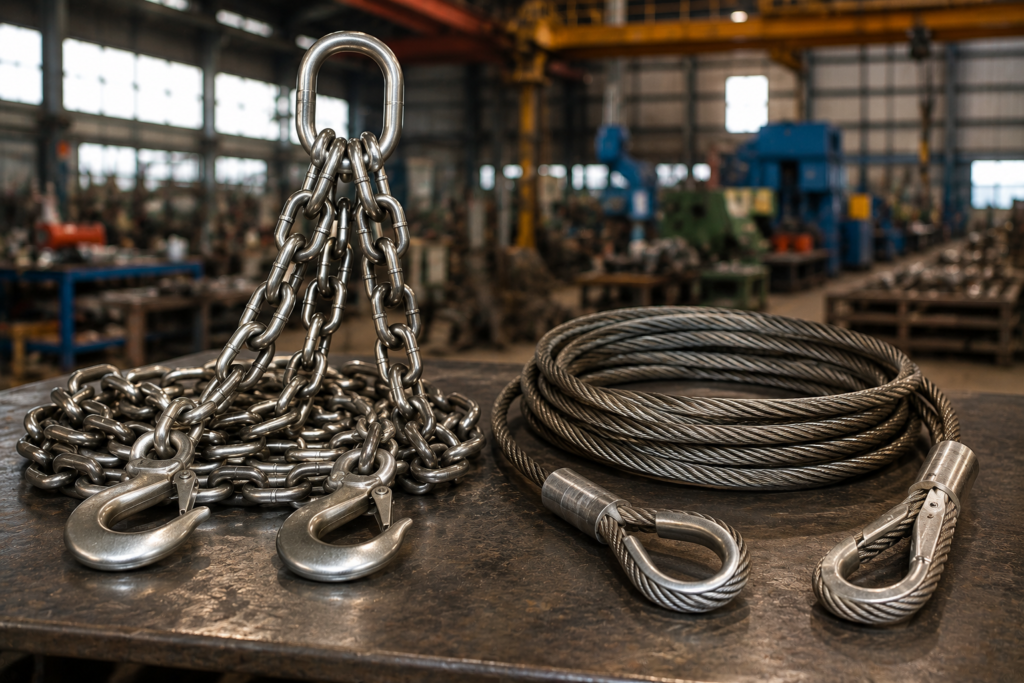
When evaluating a stainless steel sling, the choice often comes down to chain slings versus wire rope slings. Each offers distinct advantages depending on load type, handling requirements, and environmental exposure. Understanding how stainless steel chain slings compare with stainless steel wire rope slings helps ensure the correct selection for safe and efficient lifting operations.
Strength Comparison of Chain Slings and Wire Rope Slings
Strength is a primary consideration in any lifting application. Stainless steel chain slings are known for their high strength and resistance to shock loading. The individual chain links distribute stress evenly, allowing them to handle heavy loads and dynamic lifting conditions.
A stainless steel wire rope sling also offers strong load capacity, particularly in applications requiring flexibility and long lengths. Wire rope construction uses multiple strands to achieve strength while maintaining a lighter overall profile.
In direct strength comparisons, chain slings often offer greater durability against impacts and repeated heavy loads. Wire rope slings perform well under steady loads but may be more susceptible to internal wear over time.
Murphy Industrial Products, Inc. provides both sling types to support different lifting demands across industrial environments.
Corrosion Resistance in Harsh Environments
Corrosion resistance is the defining advantage of stainless steel lifting systems. Both stainless steel chain slings and stainless steel wire rope sling options are designed to withstand exposure to moisture, saltwater, and chemicals.
Chain slings offer solid metal construction that resists surface corrosion when properly maintained. Wire rope slings, however, may trap moisture within internal strands, which can lead to hidden corrosion if not inspected regularly.
In environments with constant exposure to water or cleaning agents, selecting the correct sling design becomes critical. Stainless steel components extend service life and reduce the need for frequent replacement.
Murphy Industrial Products, Inc. supports application-specific selection to ensure corrosion resistance aligns with operational conditions.
Flexibility and Handling Differences
Flexibility plays a major role in rigging efficiency. A stainless steel wire rope sling is more flexible than a chain sling, making it easier to wrap around irregular loads or use in choker configurations.
Stainless steel chain slings, while less flexible, offer better shape retention and control during lifting. Their rigid structure helps maintain positioning, especially when lifting heavy or structured loads.
Handling differences also affects operator preference. Wire rope slings are generally lighter and easier to maneuver, while chain slings provide durability in demanding lifting environments.
Choosing between flexibility and control depends on load geometry and lifting method.
Maintenance and Lifespan Comparison
Maintenance requirements vary between sling types. Stainless steel chain slings are easier to inspect visually. Damage such as cracks, elongation, or deformation can be identified quickly.
Wire rope slings require more detailed inspection. Internal strand damage may not be visible externally, and broken wires can indicate underlying wear.
In terms of lifespan, chain slings often last longer in heavy-duty environments due to their resistance to abrasion and impact. Wire rope slings perform well in lighter-duty or controlled applications but may require more frequent inspection and replacement.
Murphy Industrial Products, Inc. provides durable stainless steel lifting solutions designed for long-term performance and compliance.
Choosing the Right Stainless Steel Sling
Selecting between stainless steel chain slings and stainless steel wire rope slings depends on the application requirements. Chain slings offer strength, durability, and easier inspection, making them suitable for heavy and repetitive lifting tasks. Wire rope slings provide flexibility and lighter handling, ideal for specific configurations and load shapes.
A properly selected stainless steel sling improves safety, extends service life, and supports reliable lifting performance in corrosive environments. Murphy Industrial Products, Inc. supplies certified lifting solutions to meet industrial standards and operational demands.
Choosing the right sling ensures safe, efficient lifting across a wide range of industrial applications.